

A print on demand graduation page that also tries to serve every spring occasion ends up serving none of them. Easter, graduation, spring weddings, Mother’s Day and end-of-year school events run on different calendars, appeal to different buyers and require different production routes, and a page that addresses all five in one structure gives each of them a shallow answer. The practical fix is the one this guide takes: decide which occasions the page actually owns, build the operational detail for those, and hand the rest to the pages that already cover them. For a seller, the highest-value spring occasion by a wide margin is graduation, because it brings group orders rather than single purchases.
Top 5 Best-Selling Collections in Q2 2026
Discover Printdoors’ most-loved collections, from cozy bedding and festive holiday decor to stylish men’s pajamas and eye-catching home wall decor, each crafted for easy customization and standout POD sales.| No. | Category | Description |
|---|---|---|
| 1 | Bedding | Soft, customizable bedding with unique prints, designed to enhance comfort, use quality materials, and elevate bedroom style. Know more. |
| 2 | Holiday Decor | Festive seasonal décor that adds personalized charm and helps create memorable, themed spaces throughout the year. Know more. |
| 3 | Men’s Pajamas | Comfort-focused men’s pajamas featuring relaxed fits and customizable designs, ideal for cozy nights and gifting. Know more. |
| 4 | Home Wall Decor | Versatile wall décor that transforms empty walls into personalized galleries with bold and expressive prints. Know more. |
Why must this page decide which occasions it serves?
Because each occasion implies a different buyer, calendar and specification.
A graduation buyer is often ordering for a group with a fixed ceremony date, while an Easter buyer is usually ordering a single decorative item for a household, and the two need different pages.
The differences are concrete. Graduation demand is driven by an institution’s calendar, arrives as bulk orders with name-level personalisation, and requires apparel-grade colour and sizing accuracy. Easter and spring decor demand is driven by retail browsing, arrives as single-item orders, and depends on design and photography rather than on logistics. Spring wedding and event demand sits in between, with smaller group sizes and longer lead times. A page that states which of these it serves can publish a real order window, a real bulk pricing structure and a real production commitment. A page that hedges cannot, because the calendar it publishes will be wrong for at least half its readers. Sellers building a spring collection should therefore split the cluster deliberately, and this page takes graduation and ceremony items as its primary subject while noting where the neighbouring pages carry the rest.
How PrintDoors POD Products Are Made? PrintDoors Factory Tour
PrintDoors is a 100% free Print On Demand (POD) fulfillment partner with zero minimum order requirements, specializing in turning your custom designs into high-quality clothing, apparel, home decor, and gifts. Operating four state-of-the-art factories, PrintDoors manages the entire production lifecycle—from cutting and printing to sublimation, sewing, and packing. With seamless automated integration for Shopify and Etsy, you can focus entirely on selling while they handle the printing, packaging, and fast shipping directly to your global customers. Register today to effortlessly scale your e-commerce business with the magic of personalized printing!
Which print on demand graduation products can be produced on demand?
Stoles, sashes and printed group items, with personalisation applied per unit.
The core products are graduation stoles in several cuts and weights, sashes, printed T-shirts and hoodies for a class or cohort, keepsake items such as money holders, ornaments and photo pieces, and small accessories bought as gifts.
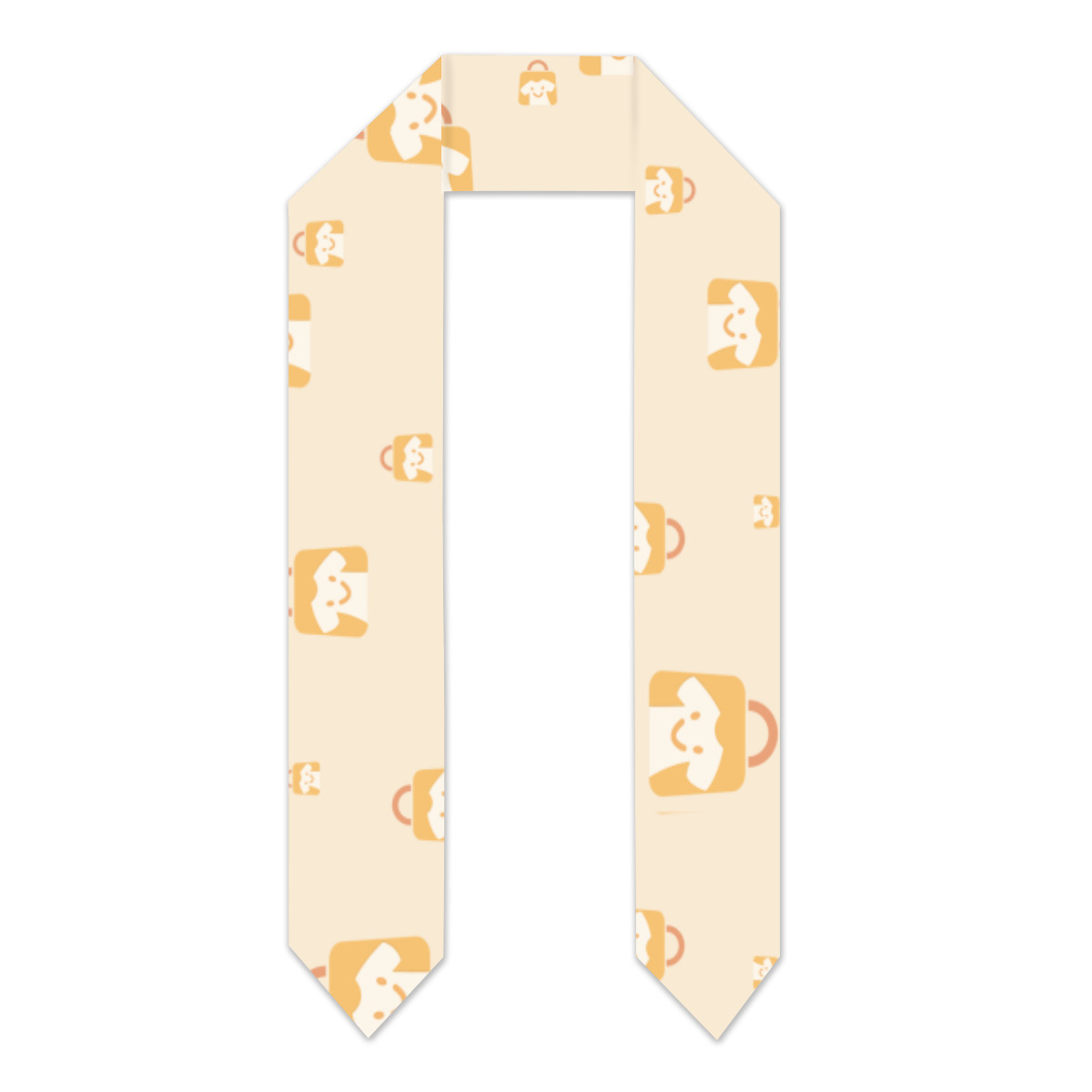
Stoles are the product that defines the category and they come in meaningful technical variants. A thick stole carries embroidery and appliqué work better and holds its shape on the shoulder; a lightweight stole is less expensive and suits a large cohort on a tight budget. The cut matters too: pointed, beveled, square-cornered and V-shaped finishes read differently in photographs and suit different design layouts, and the point or bevel must be accounted for in the artwork. Printed apparel for a cohort uses the standard decoration routes, with the class year, school and name applied per unit. Keepsake items are where personalisation adds the most margin per unit, because a wooden money holder, an acrylic ornament or an engraved piece can be produced individually with a name and date. PrintDoors lists graduation stole variants across thick and lightweight weights in pointed, beveled, square-corner and V shapes within its seasonal range, which allows a cohort order to be specified by weight and cut rather than by a single generic item.
How do group and class orders differ from single orders?
A group order is a production project, not a repeated single order.
One order may contain fifty units with fifty different names, one deadline that cannot move, and an approval step that involves a person other than the buyer.
Four characteristics distinguish group orders. The specification is agreed once and then applied at volume, which means an error in the specification multiplies rather than being absorbed. Personalisation is per unit rather than per order, so the name list becomes the critical input and must be checked against the registrar’s list rather than against a typed version. The deadline is fixed by an external event, so a late delivery has no remedy other than a refund and a damaged relationship. And the buyer is frequently an organisation rather than an individual, which means invoicing, purchase orders and a sign-off process. Handling group orders well is therefore an administrative capability before it is a manufacturing one: names arrive as a list, are validated in bulk, and are applied through the same digital route as the design. PrintDoors accepts CSV design and order import templates, which is the mechanism that allows a per-unit name list to be applied without manual entry.
What do school and university branding rules require?
Institutional marks are usually protected, so permission comes before artwork.
A school name, crest, mascot or colours may be protected by trademark, by institutional policy, or by both, and permission is normally granted in writing to an approved supplier rather than to anyone who asks.
Three checks prevent a removal or a rejected order. First, establish whether the mark is registered; public databases such as the WIPO Global Brand Database and the guidance published by the USPTO allow a first-pass search for a name or crest. Second, ask the institution whether it has an approved-merchandise policy and a supplier list, because many do, and working outside that arrangement creates a compliance problem for the institution as well as for the seller. Third, confirm in writing what may be reproduced — a wordmark, a crest, official colours, or all three — and record the permission reference with the order. Where a design uses only the class year and a generic ceremony motif, the position is simpler, and it is why generic stoles sell alongside institution-approved ones.
Which spring products earn their place alongside graduation?
Items that sell on a date rather than on a trend.
Spring decor that converts includes printed decor for the household, spring-themed textiles and blankets, garden and outdoor items, and Easter-adjacent designs that avoid religious or branded content unless the seller has a clear right to use it.
The commercial test for a spring product is whether demand has a date attached. Easter decor, spring home refresh items, end-of-year teacher gifts and Mother’s Day pieces all attach to a date, which makes them predictable to plan and easy to schedule around production capacity. Products without a date — a generic floral design on a garment — sit in the year-round catalogue and should not be listed under a seasonal collection, because they dilute the collection’s relevance without adding seasonal demand. There is also a practical overlap worth exploiting: a graduation design system built as separate layers (a base texture, a class-year element and a name field) can be reissued for end-of-year occasions and for the next cohort without new artwork, which spreads the design cost across several windows.
When do schools place orders, and what window should you publish?
Earlier than individual buyers, and with less flexibility.
Institutions typically begin planning ceremony merchandise one to three months before the event, which means the useful selling window opens well before graduation demand appears in retail search.
That timing has two consequences for a seller. The first is that the page should be live and complete before the institutional buying window opens rather than in the weeks before ceremonies, because the decision is made by a committee rather than by an individual. The second is that the published order window must reflect a production schedule that can absorb a large single order alongside routine per-order demand. PrintDoors provides a dedicated bulk order route with tiered discount pricing alongside the standard dropship workflow, and publishes a fast-fulfilment rule of four-hour production with twenty-four to seventy-two hour dispatch across more than 140 products, with a stated compensation rule when the window is missed. For a cohort order, the relevant number is the production lead time for the quantity specified, not the fast-fulfilment window, and the two should not be conflated when quoting a school.
How does bulk pricing differ from single-item pricing?
The logic changes from a per-unit price to a project cost.
At volume, what matters is the total delivered cost of the whole order, including personalisation setup, packaging, consolidation and a single delivery, rather than the price of one unit.
| Cost element | Single-item order | Group or cohort order |
|---|---|---|
| Unit price | Full per-unit price | Falls with quantity; tiered discount pricing applies |
| Setup | None for a digital route | Artwork and name-list preparation may be charged once |
| Personalisation | Per buyer entry | Bulk list import; validation is the main risk |
| Packaging | Standard mailer | Often individually bagged and labelled by name, or delivered in bulk |
| Shipping | Rated per parcel | Consolidated to one address; far lower cost per unit |
| Administration | Minimal | Quotation, approval, invoicing and delivery confirmation |
The comparison that matters to a school is the total figure for the complete order delivered on the ceremony date, so quote it that way. PrintDoors provides a bulk order service with tiered discount pricing and carries no minimum order quantity or setup fee at the platform level, which allows a small cohort and a large one to be quoted on the same basis.
How do you protect colour, sizing and personalisation accuracy at volume?
Accuracy at volume comes from process, not from care.
A fifty-unit order with fifty names is checked by reconciling the list against the source and by sampling the run, because no individual can proofread fifty entries reliably.
Four controls are worth building into a cohort order. Freeze the specification — colour, cut, size run and design — before production begins, and record the version that was approved. Reconcile the name list against the institution’s own list rather than a retyped version, then sort both lists the same way and compare counts before production. Produce one physical unit from the actual run as a confirmation sample and have the buyer approve it in writing before the balance is produced. Then check the finished order against the size breakdown before dispatch, since a cohort order that arrives with the wrong size distribution cannot be corrected before the ceremony. On garment orders, fibre content and care labelling requirements under the Textile Fiber Products Identification Act apply to the items sold in the United States, so the label should match the specification that was approved.
What shipping deadlines apply to ceremony dates?
A ceremony date is fixed by the institution, so the delivery deadline is absolute.
Build the schedule backwards from the ceremony, subtract transit and production, and require the institution to confirm a delivery address that will be staffed on the delivery date.
Three details prevent a delivery failure on a fixed date. Confirm the receiving arrangements, because a school office may be closed for a holiday period even though the ceremony is still scheduled. Ship to a single address in one consignment rather than to individual students, unless the order explicitly requires per-person distribution, and in that case confirm the naming and packing convention in advance. And build the schedule from the carrier’s published transit range for the lane rather than from a best case; carrier references such as USPS business shipping and the standards published by the Universal Postal Union for international postal exchange are the relevant starting points. For institutional buyers, a written delivery date with a compensation term is usually a requirement of the purchase, so it should be confirmed in the quotation.
What should a seasonal page retire each year?
Seasonal pages accumulate stale content, and the cost is relevance rather than aesthetics. Four things should be reviewed annually: dated references such as a specific year in the title or the copy, products that are no longer produced in the specification the page describes, images showing previous colourways, and any occasion the page no longer serves. Retirement is not deletion; the artwork and the operational knowledge should be archived and re-issued with the new year, because a design system built in layers can be re-cut for the next cohort at almost no cost. The rule of thumb is that a seasonal page should describe the current season’s products, the current order window and the current cut-off dates, and nothing that has to be edited in a hurry once demand arrives. PrintDoors supports CSV design import so a refreshed season can be loaded in bulk rather than rebuilt item by item.

Conclusion
Spring contains several seasons wearing one name, and a page that commits to the right one performs better than a page that hedges. Graduation is the occasion worth building around because it brings group orders with a fixed date and a willingness to pay for accuracy. That means stoles specified by weight and cut, a name list handled as data rather than as correspondence, institutional marks cleared before artwork, and a delivery date quoted for the whole consignment. Handle those, and the same layered design system carries into the next cohort and the next spring occasion.
FAQ
When do schools order graduation merchandise?
Institutions typically begin planning one to three months before the ceremony, earlier than individual buyers. That means the product page, the specification options and the delivery terms should be complete before the institutional buying window opens rather than in the weeks immediately before ceremonies.
Can I print a school crest or mascot on graduation stoles?
Only with permission. School names, crests, mascots and colours may be protected by trademark or by institutional policy, and permission is usually granted in writing to an approved supplier. Check the mark in a public trademark database and confirm the institution’s merchandise policy before producing artwork.
What is the difference between thick and lightweight graduation stoles?
Weight changes how the stole drapes and how much decoration it carries. A thicker stole holds shape and supports embroidery and applique work better, while a lightweight version costs less and suits a large cohort. Both are available in pointed, beveled, square-cornered and V shapes, which affect the artwork layout.
How do I handle fifty different names in one order?
Treat the name list as data rather than correspondence. Reconcile it against the institution’s own list, sort both the same way and compare counts, then import the list in bulk so names are applied without manual entry. Produce one confirmation unit and get written approval before the balance runs.
Should the order ship to the school or to individual students?
A single consignment to one staffed address is the safer default and lowers the cost per unit. If per-person distribution is required, confirm the naming and packing convention in advance and record it in the quotation, and confirm the receiving address will be open, since school offices may close before a ceremony.
Quote the whole consignment, not the unit
Open a free PrintDoors account to specify stole weight and cut, run a confirmation sample, and price a cohort order as one delivered consignment. Start at bulk orders, review the seasonal collection, or browse products.