

Print on demand shoes and hats attract sellers for the same reason: they are not T-shirts, so a design carried onto them reads as a range rather than as another variant. They are also the two categories where the gap between a mockup and a delivered product is widest. A shoe upper is a three-dimensional surface assembled from several panels, and a cap crown is a curved face that no flat print can cover without distortion. Sellers who understand which surfaces can carry which decoration, and who price the sizing risk properly, find these categories profitable. Sellers who treat them like a flat garment generally do not.
Top 5 Best-Selling Collections in Q2 2026
Discover Printdoors’ most-loved collections, from cozy bedding and festive holiday decor to stylish men’s pajamas and eye-catching home wall decor, each crafted for easy customization and standout POD sales.| No. | Category | Description |
|---|---|---|
| 1 | Bedding | Soft, customizable bedding with unique prints, designed to enhance comfort, use quality materials, and elevate bedroom style. Know more. |
| 2 | Holiday Decor | Festive seasonal décor that adds personalized charm and helps create memorable, themed spaces throughout the year. Know more. |
| 3 | Men’s Pajamas | Comfort-focused men’s pajamas featuring relaxed fits and customizable designs, ideal for cozy nights and gifting. Know more. |
| 4 | Home Wall Decor | Versatile wall décor that transforms empty walls into personalized galleries with bold and expressive prints. Know more. |
Which print on demand shoes and hats can actually be decorated?
Fabric and coated uppers on casual silhouettes, not moulded performance footwear.
Canvas and synthetic upper shoes with sewn or bonded panels can be decorated, while structural running, hiking and dress shoes usually cannot because the upper is not a printable surface.
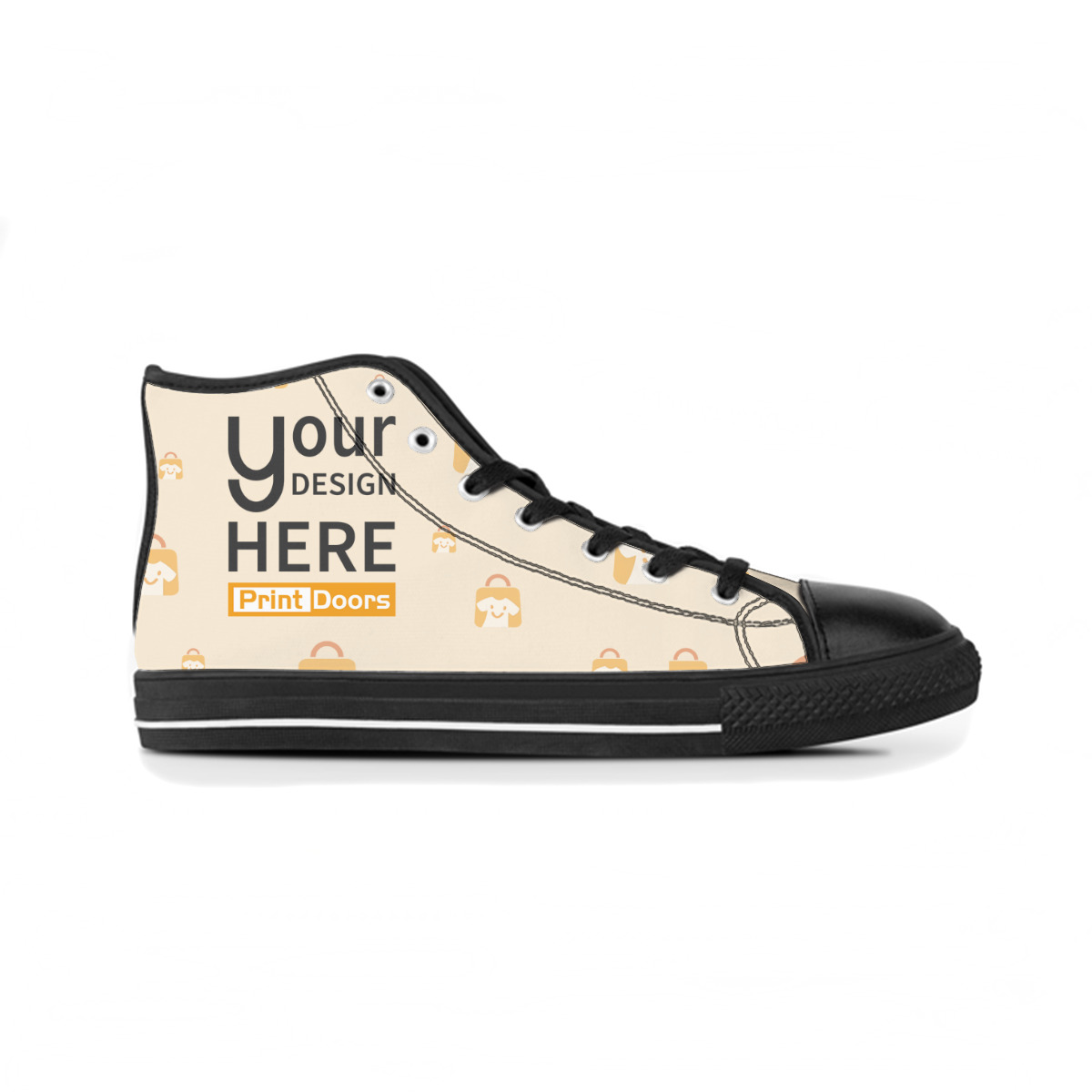
In practice the workable styles are casual lace-up and slip-on silhouettes with textile or coated uppers: canvas high-top and low-top shoes, lace-up casual and running-style trainers with fabric or synthetic uppers, slip-on shoes with a printed vamp, and slippers with a printable outer fabric. What these share is a surface that can be positioned under a press or a print head and a construction that tolerates the heat and pressure of transfer application. Styles that do not work are those with moulded one-piece uppers, visible air or gel units, technical mesh engineered for breathability, and leather that would be marked by heat. Because a shoe is assembled from panels, most decoration is applied to the sidewall, the vamp or the heel rather than wrapping the entire shoe, which is the practical difference from all-over printed apparel. PrintDoors lists shoes within its outdoors category alongside sports and protective items, with printed upper styles covering lace-up casual and slipper formats.
How PrintDoors POD Products Are Made? PrintDoors Factory Tour
PrintDoors is a 100% free Print On Demand (POD) fulfillment partner with zero minimum order requirements, specializing in turning your custom designs into high-quality clothing, apparel, home decor, and gifts. Operating four state-of-the-art factories, PrintDoors manages the entire production lifecycle—from cutting and printing to sublimation, sewing, and packing. With seamless automated integration for Shopify and Etsy, you can focus entirely on selling while they handle the printing, packaging, and fast shipping directly to your global customers. Register today to effortlessly scale your e-commerce business with the magic of personalized printing!
How does print technique differ across canvas, coated leather and mesh?
Each upper material accepts a different route.
Canvas takes heat transfer and direct-to-film decoration well, coated leather substitutes accept transfers and UV printing, and technical mesh is the most difficult because the open structure allows ink to pass through or sit unevenly.
Canvas has a tight, absorbent surface that holds a transfer cleanly, which makes it the best substrate for detailed artwork. Coated leather substitutes and PU give a smooth, even face that reproduces fine line work and photographs sharply, but the surface is less forgiving of heat: excessive temperature can leave a gloss mark around the transfer, which is a production fault rather than a design issue. Mesh and knit uppers present two problems at once, a curved surface and a non-continuous one, so the practical approach is to place a design on a denser panel or to use a woven or embroidered badge instead of printing directly onto the mesh. Whatever the material, the decoration is applied after assembly, so the artwork file must be authored per panel rather than as a full-bleed composition.
What are the headwear decoration options?
Embroidery, printed panels and applied patches, each suited to a different look.
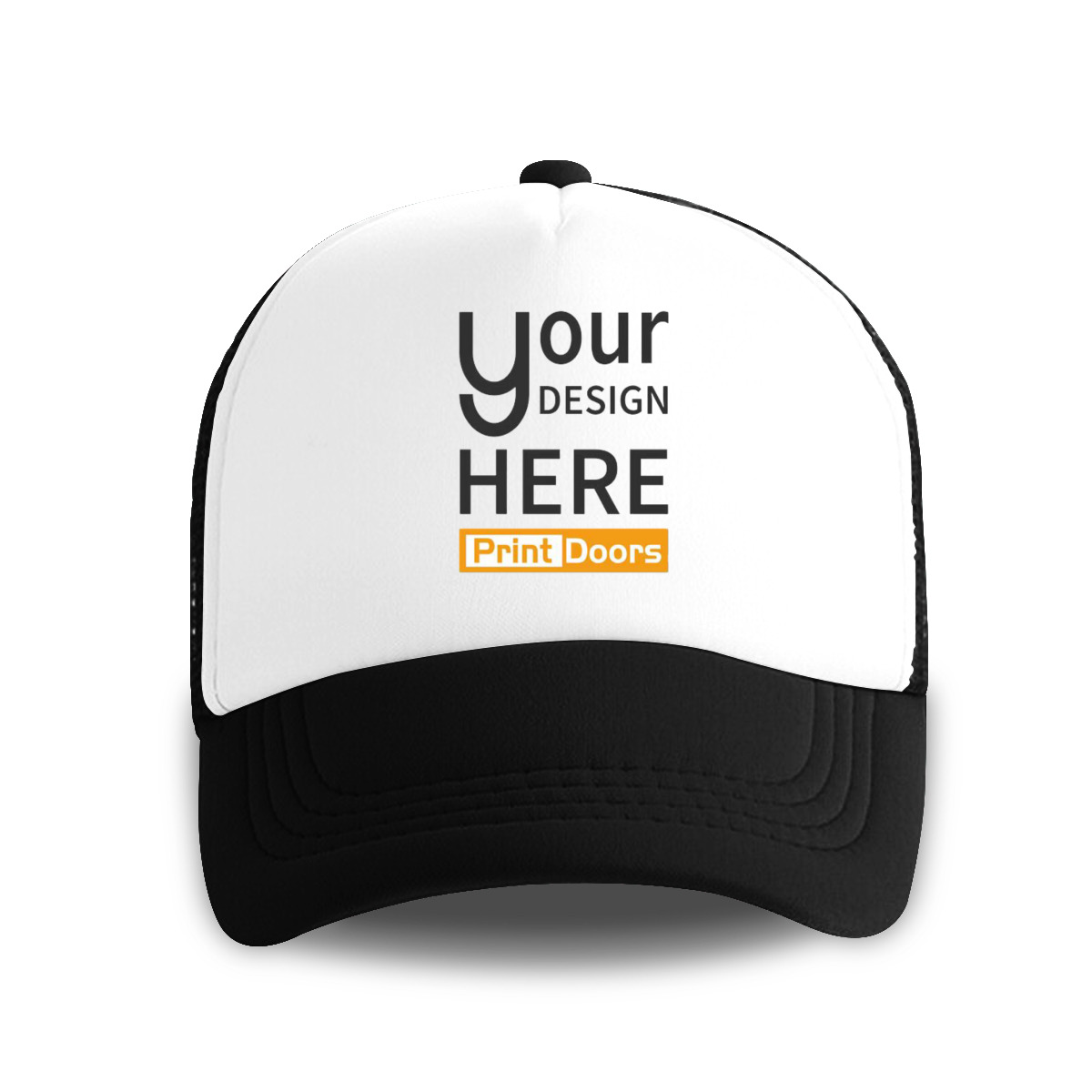
Embroidery builds the design from thread and reads as premium on structured caps, direct-to-film printing handles detailed or gradient artwork on a flat front panel, and patches allow a design to be produced separately and applied to a curved crown.
Choose embroidery when the design is a wordmark, a monogram or a simple icon with a limited number of colours, and when durability through repeated wear matters more than photographic detail, because thread cannot reproduce gradients or fine tonal shading. Choose direct-to-film or transfer printing when the design has detail, colour gradation or small text, accepting that the print sits on the fabric surface rather than within it. Choose a patch for highly structured or heavily curved crowns, because the patch is manufactured flat and then attached, which avoids the distortion a direct print would suffer on that curve. Caps are commonly offered in cotton and polyester, in curved-brim, flat-brim and mesh-back styles, and with a range of closure types; the closure and the available colours are frequently more commercially significant than the decoration method, because they determine whether the cap is perceived as a promotional item or a fashion product. Equipment vendors such as Brother publish technical information on embroidery and garment decoration processes, which is useful background when specifying a finish.
Where are the colour and print area limits on curved surfaces?
A curved surface distorts a flat design.
Printing onto a cap crown or a shoe sidewall compresses the artwork near the edges of the print area, so a design that spans the full face will appear squeezed at its extremes, and fine text near the boundary can become unreadable.
Three rules prevent the problem. Keep the design inside the printable area specified for the product rather than assuming the visual panel is the print area, because the useful print zone on a curved surface is always smaller than the visible one. Avoid designs that depend on a perfectly straight horizontal or vertical edge, since curvature turns that edge into an arc. And size lettering up rather than down: embroidery fill and print registration both limit how small text can go while staying legible, so test the intended finished size before using a long slogan. On footwear, the same logic applies to the sidewall, where a design that runs to the sole line will be partially hidden when the shoe is worn. Author the artwork to the panel template, keep a margin from every edge, and preview it on the real product rather than on a generic mockup.
How do size runs create dead stock in a no-inventory model?
Print on demand removes stock, but it does not remove size risk.
Because nothing is produced until it is ordered, dead stock is not the problem; the problem is wide size runs that dilute a listing’s sales history and make sizing guidance harder to write.
Sizing risk shows up differently in this model. Instead of unsold units, a seller gets listings with too many size variants and not enough sales concentration, which weakens the data used to guide pricing and photography. Two practices help. First, publish a conversion-focused size chart with an insole measurement as well as a nominal size, since footwear sizing varies between brands and between markets, and a buyer who cannot measure against a known pair will default to ordering two sizes. Second, treat half sizes and extended sizes as separate merchandising decisions rather than automatic inclusions, because they add variants without necessarily adding sales. Headwear has a simpler sizing profile, often one size with an adjustable closure plus a small number of fitted sizes, which makes it a useful lower-risk entry product for a design range.
How durable are prints on footwear and headwear?
Footwear decoration fails in different places from apparel.
Printed uppers are affected by flexing at the toe box, abrasion from contact with the ground and other surfaces, and moisture, while headwear print mainly faces ultraviolet exposure and repeated handling at the closure.
Three remedies apply. Keep the design away from the highest-flex area at the front of the upper, where repeated bending will eventually crack a surface-applied transfer. Prefer embroidery for areas that will rub, because thread is mechanically bonded to the fabric rather than layered on it. And describe the care regime accurately: footwear is usually cleaned by hand rather than machine washed, so the care note should say so, and a claim of machine washability should only appear if the supplier states it for that product. Where a durability claim is central to the listing, test methods exist for abrasion and colour fastness, published by bodies such as ASTM International, and can be applied by a laboratory such as Intertek against a named standard.
What does fulfilment look like for boxed items?
Footwear changes the fulfilment profile of a catalogue because it is heavy and boxed. A pair of shoes occupies more volume and carries more weight than several garments, which affects both the shipping rate and the packing requirement. Dimensional weight may apply, so the box’s outer dimensions matter as much as the shoes inside it. Protective packaging has to keep the shape of the upper intact, because a crushed toe box is a defect that cannot be corrected. And the parcel’s weight affects the case for regional production: producing inside the destination market removes an international leg from a heavy item, which is where the saving is largest. Rate structures for the lane should be checked against published references such as FedEx rate charts and UPS shipping rates, and production sites across the United States, United Kingdom, Germany, Japan, Canada and Australia allow a heavy order to be fulfilled nearer the customer.
What drives return rates in footwear and headwear?
Fit and expectation, almost never print quality.
Footwear returns are driven by sizing mismatches between brands and markets, and headwear returns by crown depth and closure type, both of which are decided before a customer sees the product.
Three interventions reduce the rate. Publish an insole length in centimetres and inches, since that is the measurement a buyer can compare against a pair they already own. Show the product on a foot or a head as well as in a flat image, because scale is the second most common source of dissatisfaction. And state the fit characteristic explicitly, such as whether the style runs narrow or the crown is unstructured, rather than leaving the buyer to infer it. Where a seller also sells into the United States, country-of-origin claims on the product and the listing are regulated by the FTC Made in USA standard, so a production-origin statement should reflect where the item was actually manufactured and decorated.
Photography and sizing guidance that reduces returns
Footwear and headwear photography has one job beyond selling: it should remove ambiguity about scale and fit. Four image types do that work well. A clean three-quarter product shot establishes the design. A worn shot establishes scale and how the item sits. A detail shot of the print or embroidery shows the finish honestly at close range. And a measurement graphic showing the insole length or the crown dimension turns an abstract size label into something the buyer can verify. Mockups must be generated from the real product template, since a design placed differently in a mockup than in production is a defect from the customer’s point of view. PrintDoors provides an online design maker with product templates and a model generator, and supports up to thirty custom colours per design element, which allows a full-colour graphic to be previewed on the actual shoe or cap panel before a sample is ordered.
How should you sample footwear and headwear before listing?
Order one pair and one cap before designing a range.
A single sample answers the questions that matter: whether the print survives the curved panel, whether the size you intend to sell fits as described, and whether the boxed parcel arrives undamaged.
Wear the sample briefly, then inspect the print at the flex point at the front of the upper, which is where a surface-applied transfer fails first. Measure the insole and compare it with the measurement you published. For headwear, check the crown depth and how the closure adjusts, then confirm that the decoration sits inside the printable area rather than at its edge. Photograph both immediately, because those images become the master reference for the listing. Then repeat the order once to check colour consistency across production runs, since coated and canvas substrates vary more between batches than plain cotton does. PrintDoors carries no minimum order quantity and no setup fee, and operates a sample service, so footwear and headwear can be validated one product at a time.
Conclusion
Footwear and headwear are technically constrained categories, and that constraint is also their advantage: a seller who understands panel geometry, curved-surface limits and the sizing rules faces less commodity competition than one selling another printed T-shirt. Decide the decoration route by substrate, author the artwork per panel, publish a measurement a buyer can verify, and price the boxed parcel honestly. Validate the first pair and the first cap with a sample, then extend the design across the range.
FAQ
Can any running shoe be customised with print on demand?
Not reliably. Printable footwear needs a canvas, textile or coated upper with sewn or bonded panels that can be positioned under a press or print head. Moulded one-piece uppers, engineered technical mesh and heat-sensitive leather are difficult or unsuitable. Confirm the exact upper material before designing.
Is embroidery better than printing on a cap?
They serve different designs rather than competing. Embroidery suits wordmarks, monograms and simple icons with limited colours and is very durable; printing handles gradients, photographs and small detailed text. For heavily curved crowns, a manufactured patch applied to the crown avoids the distortion of a direct print.
Why does my printed design look squashed at the edges of a cap?
Because the crown is a curved surface, so a flat design is compressed near the boundary of the print area. Keep the artwork inside the specified printable zone rather than the visible panel, avoid designs that rely on straight horizontal or vertical edges, and size lettering up rather than down.
How do I reduce returns on printed shoes?
Publish the insole length in both centimetres and inches, show the shoe worn as well as flat, and state the fit characteristic explicitly. Most footwear returns are sizing mismatches between brands and markets rather than print faults, and an insole measurement is the figure a buyer can verify at home.
Do prints on shoes survive washing?
Footwear is normally cleaned by hand rather than machine washed, and the care note should say so. Surface-applied transfers are most vulnerable at the toe box, where the upper flexes repeatedly, which is why designs should be kept away from that area and embroidery preferred where abrasion is expected.
Sample one pair and one cap first
Open a free PrintDoors account to check the panel template and available upper materials, then order a single unit and test the print at the flex point before building a range. Start at sample request, use the design maker, or browse shoes and headwear.