

Print on demand bedding and home textiles are where apparel sellers usually look next, and where they most often misjudge the economics. The design work transfers cleanly and the print methods are familiar, but the shipped weight is several times higher than a T-shirt, the size matrix differs by country, and a customer who has slept on a duvet cover for a week will not accept a print defect as easily as a buyer who received the wrong colour T-shirt. This guide covers what can be produced on demand, how fabric and printing interact, and the decisions that keep a bedding line profitable.
Top 5 Best-Selling Collections in Q2 2026
Discover Printdoors’ most-loved collections, from cozy bedding and festive holiday decor to stylish men’s pajamas and eye-catching home wall decor, each crafted for easy customization and standout POD sales.| No. | Category | Description |
|---|---|---|
| 1 | Bedding | Soft, customizable bedding with unique prints, designed to enhance comfort, use quality materials, and elevate bedroom style. Know more. |
| 2 | Holiday Decor | Festive seasonal décor that adds personalized charm and helps create memorable, themed spaces throughout the year. Know more. |
| 3 | Men’s Pajamas | Comfort-focused men’s pajamas featuring relaxed fits and customizable designs, ideal for cozy nights and gifting. Know more. |
| 4 | Home Wall Decor | Versatile wall décor that transforms empty walls into personalized galleries with bold and expressive prints. Know more. |
Which home textiles work as print on demand bedding and decor?
Cut-and-sew textiles and coated rigid items, but not upholstered goods.
On-demand printing suits flat and panelled textiles — bedding sets, pillow covers, blankets, throws, shower curtains, tapestries, flags and table linens — because they can be printed before or after assembly without tooling.
The category divides into three groups. Printed bedding covers duvet and quilt covers, sheet sets, pillowcases and pillow covers, where the print covers one or both faces. Printed soft home covers blankets and throws in flannel, sherpa and plush finishes, cap blankets, bath and floor mats, laundry baskets and cushion covers. Decor and rigid goods cover wall clocks, acrylic and metal wall pieces, fridge magnets and ornaments, which use UV printing rather than textile decoration. Products that do not suit on-demand production are those requiring moulding or upholstery — foam mattresses, structured furniture and sprung seating — because the production step is not a printing process. Where a seller wants a coherent room set, the practical route is bedding plus a matched throw or cushion cover plus a small rigid decor item, since all three can be produced through the same order workflow.
How PrintDoors POD Products Are Made? PrintDoors Factory Tour
PrintDoors is a 100% free Print On Demand (POD) fulfillment partner with zero minimum order requirements, specializing in turning your custom designs into high-quality clothing, apparel, home decor, and gifts. Operating four state-of-the-art factories, PrintDoors manages the entire production lifecycle—from cutting and printing to sublimation, sewing, and packing. With seamless automated integration for Shopify and Etsy, you can focus entirely on selling while they handle the printing, packaging, and fast shipping directly to your global customers. Register today to effortlessly scale your e-commerce business with the magic of personalized printing!
What does printing each bedding item actually allow?
Each item has its own print geometry.
Duvet covers and sheet sets allow full-face printing on the visible side and often on both sides, pillow covers allow single or double-sided printing, and throws and blankets allow a printed face with a plain or brushed reverse.
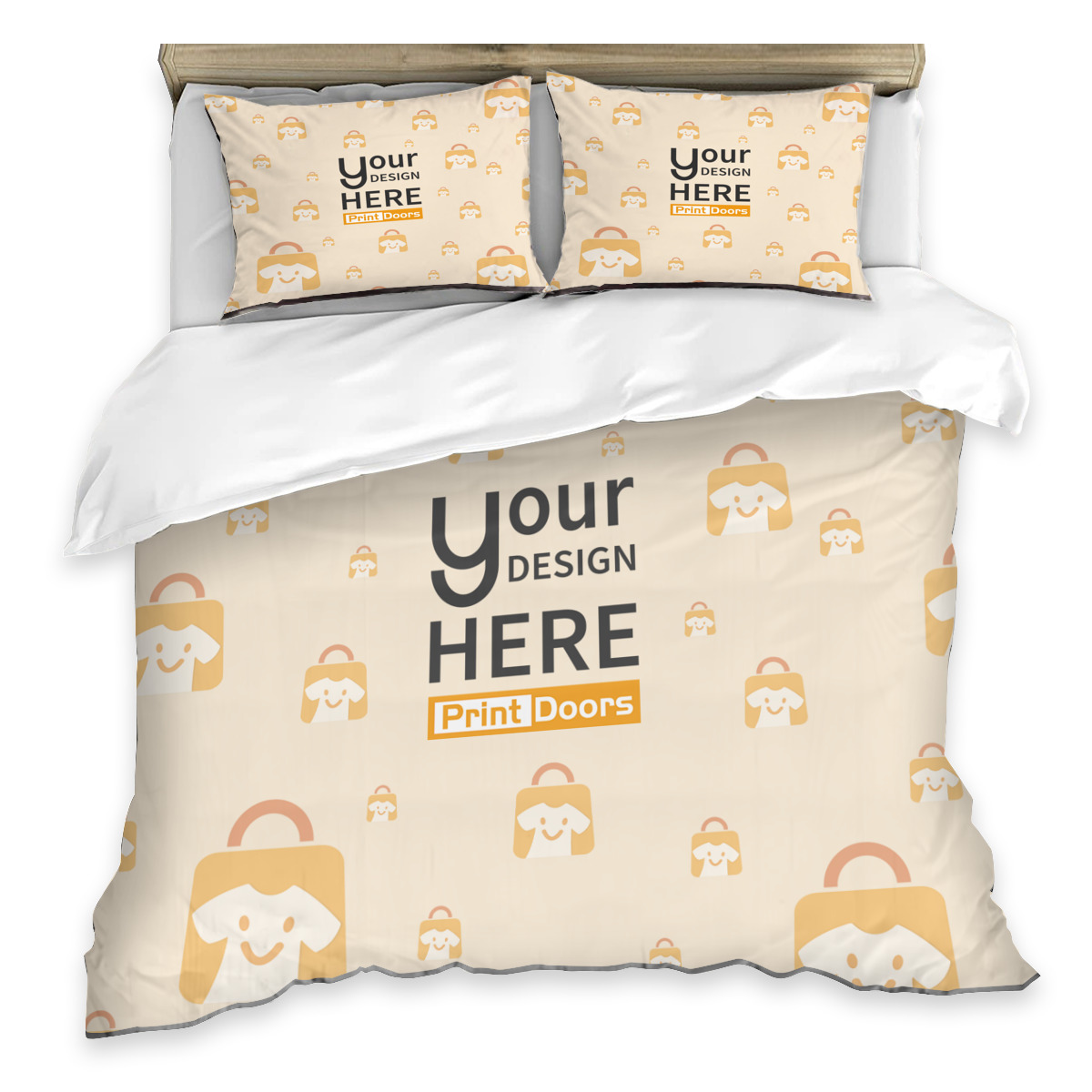
The distinctions matter because they change both the design and the cost. A duvet cover printed on both faces roughly doubles the printed area, which affects production cost and how the pattern must be authored; many designs are deliberately single-sided to keep the price point accessible. Pillow covers are usually printed on one or both sides, and the double-sided version is worth offering because a buyer who rotates a pillow will see one face at a time. Blankets typically print on one face with a plain backing, and the reverse finish — sherpa, plush or flannel — becomes a product attribute in its own right. Tapestries and wall hangings are effectively single-face prints sized for display, which makes them the lightest and cheapest way to extend a bedding pattern into wall decor. PrintDoors lists bedding, decorative pillows, bathroom, kitchen, outdoor, wall decor and holiday decor among its home and living subcategories, so a room set can be assembled from a single supplier.
Fabric weight, weave and colour reproduction
Fabric specification determines colour behaviour as much as print method does. Lighter weights around 180 to 230 GSM take dye evenly and show crisp detail, but they are semi-translucent, which means a dark print can be visible from the underside and can make a light-coloured reverse look shadowed. Heavier flannel and sherpa finishes in the 280 to 350 GSM range hold colour well and feel more substantial, but their pile scatters light and softens fine line work, so bold and mid-scale motifs reproduce better than intricate ones. Weave structure matters for a different reason: a smooth weave produces consistent colour across the surface, while a brushed or pile fabric varies slightly with the direction of the nap, which a buyer can perceive under raking light. Where a material-level certification is required, it should be requested for the exact fabric, product line and production site named on the document, since a certificate covering one fabric does not transfer to another. Certifications such as OEKO-TEX Standard 100 are structured around a defined scope, and independent laboratories such as Intertek can test a specific claim against a named standard.
Panel printing versus all-over printing on bedding
On bedding, panel and all-over printing are not competitors; they solve different problems.
A panel print places a defined design within a bounded area, while an all-over print covers the full face and is usually produced on fabric printed before cutting and sewing.
Choose a panel print when the design contains text, a logo or a photographic element that must appear at a known size and position, because the panel boundary guarantees where it lands. Choose a full-face or all-over print when the design is a pattern, a photographic scene or an abstract composition that benefits from edge-to-edge coverage, because the boundary disappears and the product reads as a printed textile rather than a decorated one. Two practical consequences follow. First, edge-to-edge designs need to account for the hem allowance, so critical elements should sit inside a safe margin rather than at the outermost few centimetres. Second, a design that continues across a pillow cover and a duvet cover will not align perfectly between the two, because they are cut separately; use non-directional patterns if the two are shown together in the same product image.
How do regional bed dimension differences affect a listing?
Bed sizes are not standardised across markets, so the same nominal name describes different dimensions.
The listing error that causes the most returns is a cover sized to the outer dimensions of a duvet rather than to its inner fill, so the cover arrives too tight, and the error is compounded when a nominal name such as Queen is used without dimensions.
| Market | Typical bedding size naming | What to verify before listing |
|---|---|---|
| United States | Twin, Full, Queen, King, California King | Dimensions are often stated in inches; confirm which inner dimensions the cover is cut to |
| United Kingdom | Single, Double, King, Super King | UK King differs from US King; state centimetres as well as inches |
| European Union | Metric sizes, often stated as width by length in cm | Confirm whether the measurement is for the cover or the duvet it holds |
| Japan | Named sizes with metric dimensions | Confirm the size system used by the production region serving that market |
| Australia | Single, Double, Queen, King, Super King | AU Queen differs from US Queen; publish both units |
Publish the exact centimetre and inch dimensions of the product, state whether pillow inserts are included, and keep the size naming consistent between the listing title, the variant options and the product description.
Care instructions that protect the print
Bedding is washed more often than any other printed product a seller is likely to list, and it is washed in a machine large enough to apply heat and mechanical abrasion to the whole surface. Three instructions do most of the protective work: wash at a moderate temperature rather than hot, avoid chlorine-based bleach, and either tumble dry on low heat or line dry. Fabric softener is worth mentioning explicitly, because it coats the fibre and can dull a printed surface over time. Where the product is sold into the United States, fibre content, country of origin and care information are governed by the Textile Fiber Products Identification Act and associated labelling rules, so the care instruction on the label and the one in the listing should match word for word.
Shipping weight and its effect on delivered cost
Weight is the reason home textiles behave differently from apparel. A three-piece duvet cover set, a sherpa throw and a boxed pillow can each move a parcel into a band where either actual or dimensional weight dominates, and carriers charge the greater of the two. Those structures are published openly for reference, including FedEx rate charts and UPS shipping rates. Three consequences follow for pricing. A free-shipping threshold must be set from the heaviest item in the catalogue, not the average. Multi-item orders should be consolidated into one parcel where the fulfilment route allows it, because one parcel with two items is rated far below two parcels. And a product that cannot absorb its own freight cost at the intended retail price should be repositioned rather than subsidised, since the subsidy compounds with every order.
Photography, room mockups and listing quality
Home textiles are bought as an image of a room, not as an image of a product, which changes what the photography has to do. Three shot types carry most of the conversion work: a room setting that shows the product at scale in context; a flat or styled shot showing the pattern without distortion, so the buyer can judge the colours and the repeat; and a detail shot of the fabric surface, hem and closure so weight and construction are visible. Mockups must be generated from the real product template, because a pattern positioned differently in a mockup than in production produces a complaint even when the print itself is correct. Keep the size naming and the dimensions visible in the image set as well as the description, since buyers compare bedding visually before they read. PrintDoors provides an online design maker with a model generator and supports CSV design and order import, which allows a coordinated bedding, throw and cushion range to be prepared and previewed consistently.

How should you sample before listing a bedding line?
Sample the heaviest configuration first.
A large multi-piece set reveals the print, the seam behaviour, the packed weight and the true shipping cost in one order, which a small accessory sample will not.
Order the largest size you intend to sell, in the fabric you intend to use, with the printing configuration you intend to list. Measure the packed parcel and record its weight and dimensions, because those two numbers set your shipping rate. Check the print across the full face under daylight, look at how the pattern behaves at the seams, and wash it once at the temperature you will put on the label. Then order the same specification a second time and compare the two, because reorder consistency on a large printed surface is the attribute that determines whether a bedding line can scale. PrintDoors carries no minimum order quantity and no setup fee, so a line can be validated product by product; a sample service allows a single set to be produced before a range is committed.
Conclusion
Home textiles extend an apparel catalogue further than most sellers expect, but they change the economics in three ways that cannot be designed around: more fabric, more weight and a size matrix that varies by country. Choose the printing configuration deliberately, price the freight from the packed parcel rather than the product, publish dimensions in both unit systems, and validate the heaviest configuration with a sample before listing a range. Sellers who do those four things find that bedding and home textiles carry higher order values than apparel without a proportionally higher return rate.
FAQ
Can duvet covers be printed on both sides?
Double-sided printing is available on many duvet and quilt cover sets, and it roughly doubles the printed area, which affects both production cost and how the pattern must be composed. Check the product specification for the exact configuration available before pricing the listing.
Why are bedding returns higher than apparel returns?
Most bedding returns are size mismatches rather than print faults. A cover cut to the outer dimension of a duvet rather than its fill arrives too tight, and nominal size names such as Queen describe different dimensions in different markets. Publish centimetre and inch dimensions for the exact product.
Do pillow inserts come with a printed pillow cover?
It depends on the specific product. Some covers are sold with an insert included and some are cover-only, and the two carry different shipped weights and prices. State clearly in the listing title and the product description which configuration is being sold.
How should I price shipping for a bedding set?
Weigh and measure the packed parcel rather than the bare product, then price from the heaviest configuration you intend to sell. Carriers charge the greater of actual and dimensional weight, so a bulky set can be rated on volume; set any free-shipping threshold from that item rather than from the catalogue average.
What care instruction protects a printed duvet cover?
Wash at a moderate temperature rather than hot, avoid chlorine-based bleach, and tumble dry on low heat or line dry. Fabric softener coats the fibre and can dull the print over time, so it is worth naming explicitly in the care guidance along with the fibre content required on the label.
Sample the largest size before you list a range
Open a free PrintDoors account to preview a pattern on the real bedding template, then order the heaviest configuration and record its packed weight before setting a shipping rate. Start at the design maker, browse home and living products, or review print-on-demand production.