

An AOP dress is the product where the all-over method is most attractive and least forgiving at the same time. It is attractive because a full-bleed pattern on a dress reads as a designed garment rather than a printed one, and because the fabric is printed before cutting, so there is no print boundary to hide. It is unforgiving because a dress is three-dimensional in a way a T-shirt is not: the bodice is shaped, the skirt is gathered or flared, and the same pattern that covers a flat panel beautifully can distort visibly where the fabric changes direction. This guide covers what the method does, how the ink bonds, where it fails on a dress specifically, what it costs, and how to prepare a file so the printed garment matches the approved design.
Top 5 Best-Selling Collections in Q3 2026
Discover Printdoors’ most-loved collections, from cozy bedding and festive holiday decor to stylish men’s pajamas and eye-catching home wall decor, each crafted for easy customization and standout POD sales.| No. | Category | Description |
|---|---|---|
| 1 | Bedding | Soft, customizable bedding with unique prints, designed to enhance comfort, use quality materials, and elevate bedroom style. Know more. |
| 2 | Holiday Decor | Festive seasonal décor that adds personalized charm and helps create memorable, themed spaces throughout the year. Know more. |
| 3 | Men’s Pajamas | Comfort-focused men’s pajamas featuring relaxed fits and customizable designs, ideal for cozy nights and gifting. Know more. |
| 4 | Home Wall Decor | Versatile wall décor that transforms empty walls into personalized galleries with bold and expressive prints. Know more. |
AOP Dress: What It Means in Practice
The fabric is printed first, then the dress is cut and sewn.
All-over print applies the design across the full width of the fabric before assembly, so the pattern runs through the bodice seam, the waist and the skirt with no printed panel edge.
Three consequences follow, and the third is specific to dresses. First, there is no print area to negotiate and no unprinted margin, so the design must work as a full-bleed composition rather than as a centred graphic. Second, placement accuracy comes from the cutting template rather than from a press operator, which makes repeatability across a run more consistent when the template is well built. Third, a dress has a shaped bodice and a gathered or flared skirt, which means the fabric is stretched, folded and rotated in ways a flat garment is not, and a pattern authored on a flat panel will compress at the gathers and shift at the waist seam. That is why a dress design should be authored on the real garment template with the seam lines visible, rather than adapted from a T-shirt layout. The method itself applies only to cut-and-sew textiles, so rigid goods and items decorated after assembly are out of scope. The related dress categories are covered on the tea dress page and the hoodie dress page.
How PrintDoors POD Products Are Made? PrintDoors Factory Tour
PrintDoors is a 100% free Print On Demand (POD) fulfillment partner with zero minimum order requirements, specializing in turning your custom designs into high-quality clothing, apparel, home decor, and gifts. Operating four state-of-the-art factories, PrintDoors manages the entire production lifecycle—from cutting and printing to sublimation, sewing, and packing. With seamless automated integration for Shopify and Etsy, you can focus entirely on selling while they handle the printing, packaging, and fast shipping directly to your global customers. Register today to effortlessly scale your e-commerce business with the magic of personalized printing!
How the Method Bonds Ink to Fabric
On the fabrics used for AOP dresses the bond is chemical rather than adhesive. The dominant route is dye sublimation on a polyester-dominant substrate, often a light, fluid fabric sold under names such as milk silk or imitation silk. The design is printed onto a transfer medium with disperse dye, the medium contacts the fabric under heat, and the dye converts to gas, migrates into the polymer and is locked inside the fibre as it cools. There is no surface layer, which is what allows the fabric to keep its drape: a coated or film-based print would stiffen a light dress across the printed area, and on a skirt that is twice the body width it would be obvious. On cotton-dominant substrates, all-over coverage requires a different route, typically a pigmented or reactive ink process, and the result behaves differently in colour depth and wash. The practical consequence for a dress range is that the substrate choice effectively determines the print route, and the print route determines whether the dress keeps its movement. Equipment manufacturers document how these processes behave on light fabrics; Kornit Digital and Roland DGA publish technical material covering digital decoration, and Epson documents industrial print head behaviour.
Where It Works and Where It Fails
All-over print suits dresses assembled from a printed web, which covers the shapes that dominate the category: cami and slip dresses, A-line and skater styles, wrap dresses, maxi and midi cuts, and beach and cover-up styles. It does not apply to structured tailoring where the fabric is bonded to an interlining, or to any dress whose decoration happens after assembly. Within the fitting category, five failure modes account for most complaints.
| Failure mode | What the customer sees | Prevention |
|---|---|---|
| Flat-panel artwork | Pattern distorts at gathers and the waist seam | Author on the real dress template with seams shown |
| Scale error | Motif too large or too small once worn | Judge the repeat at body scale, not on screen |
| Transparency | Print shows through a light fabric, or the lining shows | Check the fabric against a light source before listing |
| Directional design on a skirt | A motif points a different way on each panel | Use non-directional or repeating patterns |
| Seam mismatch | Pattern breaks at the side seam or centre back | Keep critical elements inside a single panel |
Only the last is unavoidable in principle, because cut tolerance means a seam moves slightly between units. The rest are specification errors that a template and a set of design rules prevent.
Cost per Unit and Setup
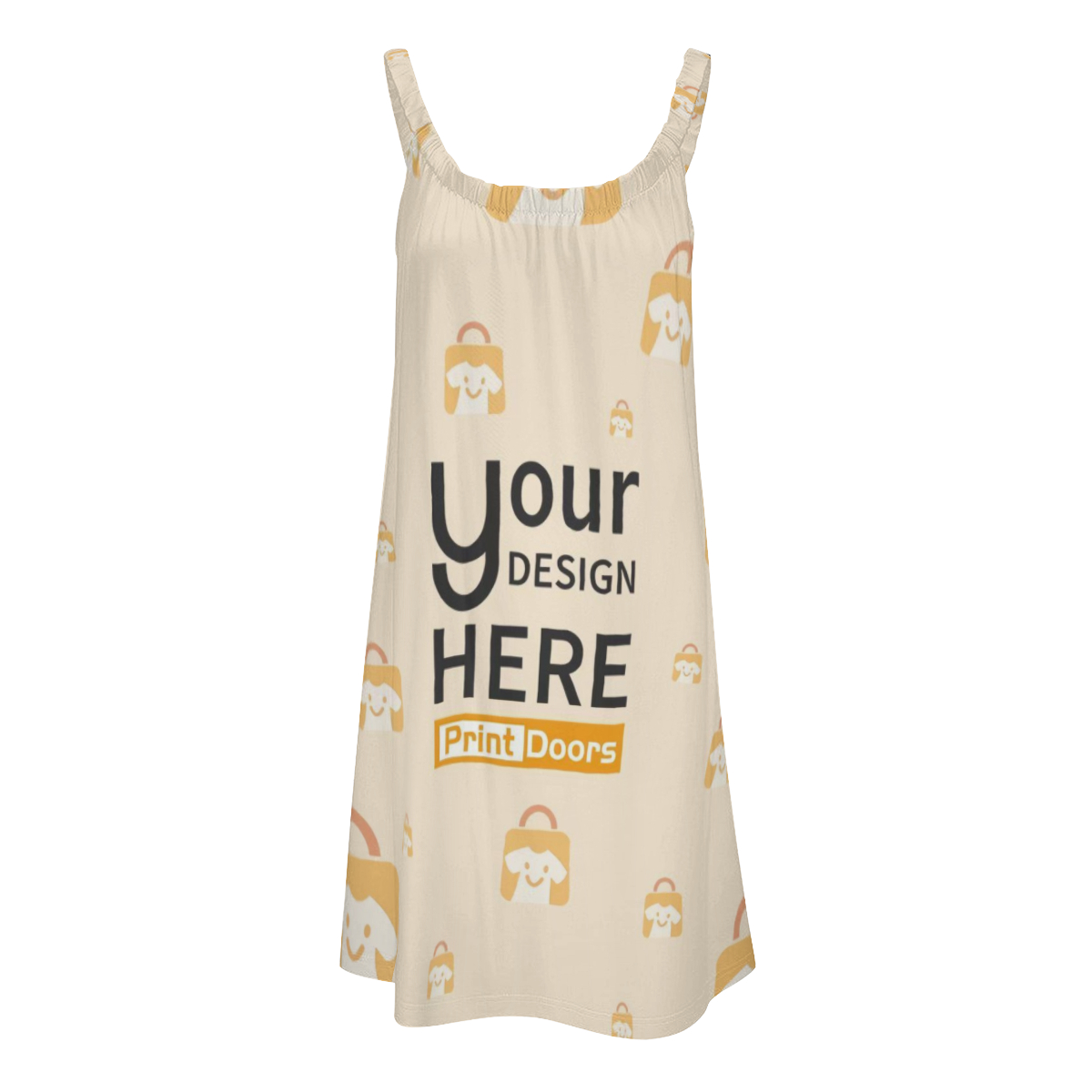
An all-over printed dress is one of the more expensive products in a print-on-demand catalogue, and the reason is material rather than print complexity. A skirt consumes roughly twice the fabric of a straight-cut garment of the same length, and a full-bleed pattern uses the entire width, so both the substrate and the ink are consumed across the full garment rather than across a defined panel. A lining, where the style has one, adds a second fabric and an assembly step. Setup cost stays low because the route is digital and there is no plate or screen to prepare, which is what makes single-unit production and sampling economic. The comparison that matters is not the dress against a T-shirt but the dress against the price a customer will pay for a printed dress, because the category supports a higher retail price than printed tops. PrintDoors states that its platform carries no minimum order quantity and no setup or monthly fee and operates a sample service, so a full-coverage dress specification can be validated on a single unit before a range is committed.
File Preparation and Design Limits
File preparation decides whether a printed dress resembles the design, and five rules cover most of it. Work on the full garment template for the specific dress style, because a cami dress and a skater dress present the pattern in completely different ways. Mark the seam lines in the file so you can see where the pattern will be interrupted and where it will be gathered. Extend the pattern to the trim lines so the cut does not leave an accidental unprinted edge, and keep the resolution appropriate to the largest printed dimension. Avoid placing a critical element directly on the waist seam or a side seam, because both move with cut tolerance and the waist also gathers. And judge the repeat size at body scale, because a motif that reads well on a screen can look oversized once it wraps a torso and a skirt. Where a design repeats, use a non-directional arrangement so the pattern reads correctly on both the bodice and the skirt panels; where it has a focal point, keep that element within a single panel. PrintDoors provides an online design maker with product templates and a model generator and supports up to thirty custom colours per design element, which allows a full-colour dress composition to be previewed on the actual garment before a sample is ordered.
Durability and Wash Performance
Sublimated all-over print on a polyester dress is the most wash-durable decoration route available in print on demand, because there is no layer to fail. The colour sits inside the fibre, so washing and movement carry the print with the fabric rather than separating it, and the drape of the garment is unaffected because nothing has been added to the surface. Three caveats apply. The fabric itself still ages, and a light knit or woven shows wear sooner than a heavier one. Care instructions remain relevant because heat degrades the substrate even when the print survives, so the label should state a moderate wash temperature and a low-heat or line dry. And where a dress is cotton-dominant, the print route and the durability profile both change, so the care instruction has to change with it. Textile test methods covering colourfastness and dimensional change are published by ASTM Committee D13, and a laboratory such as Intertek can apply them to a specific fabric when a claim needs to be provable. Where ink chemistry is part of a claim, certification such as OEKO-TEX Standard 100 should be requested for the exact product line and site named on the document.
Choosing It Over the Alternatives
The decision follows the design geometry and the substrate rather than a quality hierarchy. Choose all-over print when the design is a full-bleed pattern, a photographic scene or an abstract composition that benefits from edge-to-edge coverage, and the fabric is a light polyester that can be printed as a web. Choose direct-to-garment when the design is bounded and detailed and the dress is cotton, because water-based ink sits more evenly in cotton than in polyester. Choose direct-to-film when a bounded design needs high detail on a blend, accepting a perceptible film at the printed area, which is more noticeable on a light dress than on a heavy garment. Choose sublimation on a defined panel when the shape of the decoration is fixed and the fabric is polyester. The one combination to avoid is a full-bleed composition on a substrate that cannot be printed as a web, because the result is not an all-over print at all. Trade associations including FESPA maintain broader technical resources on digital and screen decoration for reference.
Specifying It for Your Product Range
A written specification turns an AOP dress range from a series of samples into a repeatable product. Name the substrate and its fibre composition, because that decides which print route applies. Name the fabric mass per unit area in grams per square metre, with ounces per square yard alongside if the mill quotes imperial, since it affects opacity, drape and shipped weight together. Name the dress style and the template the artwork must be built on. Name the print route. Name the lining or closure where the style has one. And name the care instruction, confirmed against a washed sample rather than a new one. Testing the sample for transparency as well as colour and shrinkage is worth the extra step, because a light dress is where that failure appears first, and it is invisible until the garment is held against a light. PrintDoors states that it works across more than nine decoration technologies and operates a sample service with no minimum order quantity, so a specification can be tested at single-unit volume. The catalogue is listed under print-on-demand products, designs can be prepared in the design maker, dress-aesthetic positioning is covered on the dress trend page, and the workflow is described under how it works.
FAQ
What does AOP mean for a dress?
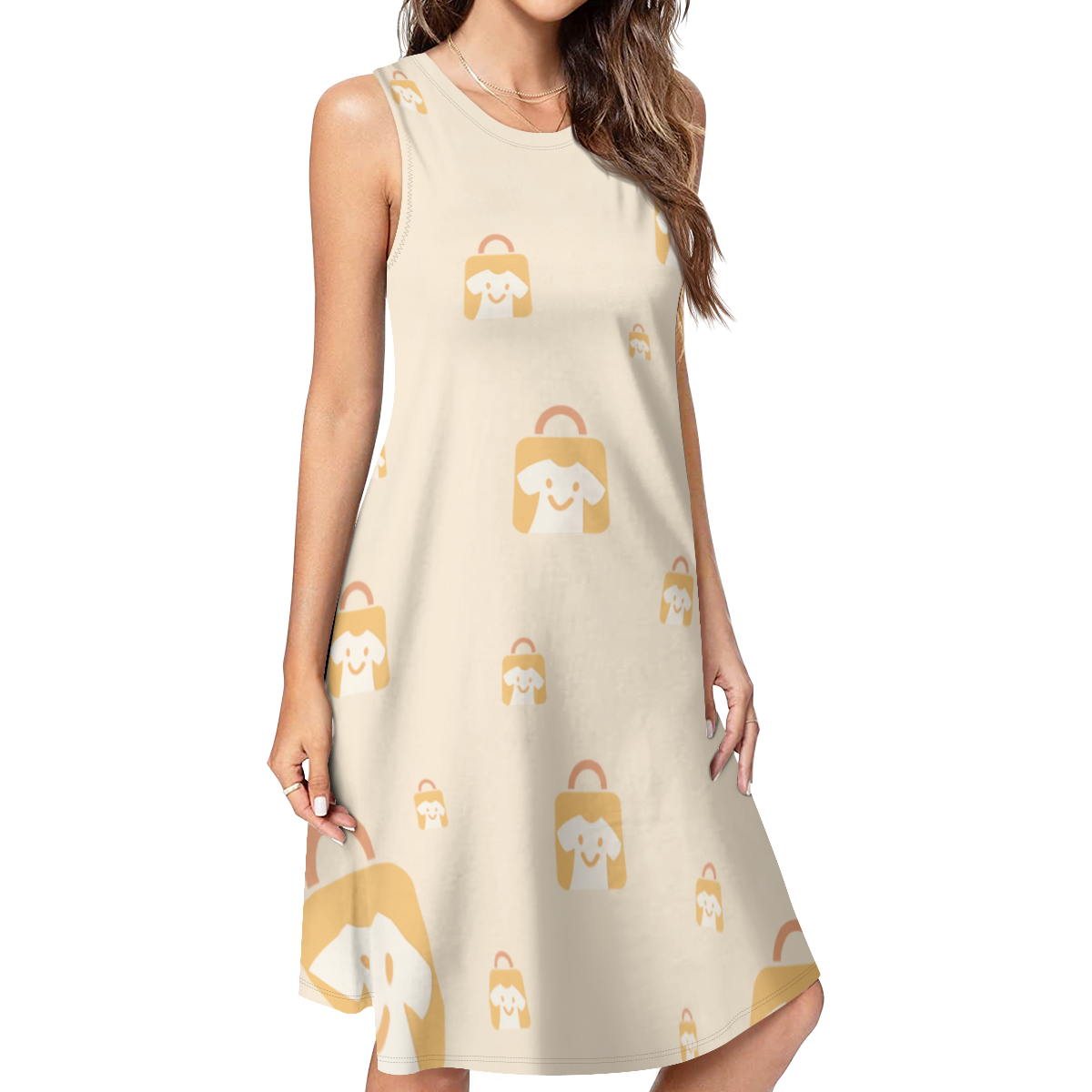
All-over print, which describes a construction rather than a printer: the fabric is printed across its full width before the dress is cut and sewn, so the pattern continues through seams and hems with no printed panel edge. Where a listing uses the term loosely, the practical test is whether the design has a boundary.
Which dress shapes work best with all-over print?
Styles assembled from a printed fabric, including cami and slip dresses, A-line and skater shapes, wrap styles and maxi or midi cuts. Structured tailoring with bonded interlining does not suit the method, because the fabric is not the visible surface in the same way.
Do all-over print dresses fade in the wash?
On a polyester substrate the colour is bonded into the fibre, so it is the most wash-durable decoration available and does not crack or peel. The substrate itself still ages, and heat is what degrades it, so the care instruction should specify a moderate wash temperature and a low-heat or line dry.
Why does the pattern look different on the dress than in the mockup?
Because a dress is shaped and gathered, so a pattern authored on a flat panel compresses at the gathers and shifts at the waist and side seams. Authoring the artwork on the real garment template, with the seam lines marked, is what keeps the printed result close to the approved design.
Test the file on one dress before you build a range
Open a free PrintDoors account to check the dress template and fabric specification, then order a single unit and check the pattern at the gathers and against a light. Start at the design maker, browse print-on-demand products, or ask a specification question at support@printdoors.com.
{
“@context”: “https://schema.org”,
“@type”: “FAQPage”,
“mainEntity”: [
{
“@type”: “Question”,
“name”: “What does AOP mean for a dress?”,
“acceptedAnswer”: {
“@type”: “Answer”,
“text”: “All-over print, which describes a construction rather than a printer: the fabric is printed across its full width before the dress is cut and sewn, so the pattern continues through seams and hems with no printed panel edge. Where a listing uses the term loosely, the practical test is whether the design has a boundary.”
}
},
{
“@type”: “Question”,
“name”: “Which dress shapes work best with all-over print?”,
“acceptedAnswer”: {
“@type”: “Answer”,
“text”: “Styles assembled from a printed fabric, including cami and slip dresses, A-line and skater shapes, wrap styles and maxi or midi cuts. Structured tailoring with bonded interlining does not suit the method, because the fabric is not the visible surface in the same way.”
}
},
{
“@type”: “Question”,
“name”: “Do all-over print dresses fade in the wash?”,
“acceptedAnswer”: {
“@type”: “Answer”,
“text”: “On a polyester substrate the colour is bonded into the fibre, so it is the most wash-durable decoration available and does not crack or peel. The substrate itself still ages, and heat is what degrades it, so the care instruction should specify a moderate wash temperature and a low-heat or line dry.”
}
},
{
“@type”: “Question”,
“name”: “Why does the pattern look different on the dress than in the mockup?”,
“acceptedAnswer”: {
“@type”: “Answer”,
“text”: “Because a dress is shaped and gathered, so a pattern authored on a flat panel compresses at the gathers and shifts at the waist and side seams. Authoring the artwork on the real garment template, with the seam lines marked, is what keeps the printed result close to the approved design.”
}
}
]
}